

Clock icon

Live on the RTR at launch

Real-time payments, 24/7/365.

Payment networks icon

One suite of APIs

For RTR, EFT, Interac e-Transfer®, Visa Direct, Mastercard Send and SWIFT.

Regulated bank icon

A regulated Canadian bank

OSFI-regulated bank with CDIC insured accounts, and member of Payments Canada.
A DCBank team member entering the Digital Commerce Bank office in Calgary

What DCBank offers on the Real-Time Rail

Digital Commerce Bank (DCBank) is a Schedule I Canadian bank and one of the first participants live on Canada's Real-Time Rail, which launched on November 9, 2026.

Businesses, fintechs and payment service providers can use DCBank to send and receive final, data-rich RTR payments 24/7/365 with other RTR participants, up to the $100,000 system limit at launch, through new APIs DCBank developed specifically for RTR payments. DCBank carries the participant connection, certification and around-the-clock operations, so you can start taking advantage of the speed of money, 24/7/365.

Why real-time payments matter in Canada

The RTR is new national infrastructure for immediate account-to-account payments, with exchange, clearing and settlement in one system, every hour of every day.

9 in 10+

The RTR will be available to more than nine in 10 Canadians within the first year after launch

Payments Canada, 2026

60%

of Canadian businesses say they are ready to adopt real-time payments

Payments Canada research

Up to $14.5B

in projected cost savings over the next decade, with launch functionality

C.D. Howe Institute

$16B

in projected economic gains over the next decade, growing to $27B as additional capabilities and use cases are introduced

C.D. Howe Institute

How the Real-Time Rail works

Business doesn't stop when banks close. On the RTR, money moves between participating institutions when the transaction happens, including evenings, weekends and holidays.

Clock icon

Available 24/7/365

Payments move around the clock, including weekends and holidays. Imagine the difference for your business.

Data icon

Every payment sent with ISO 20022 data

Invoice and remittance details can travel with each payment, for easier reconciliation and customer reporting.

Shield icon

Centralized fraud services

Canada is the first G7 country to require centralized fraud services at launch.

Final payment icon

Final and certain

RTR payments are final and irrevocable.* Guaranteed funds.

Build your RTR capabilities with DCBank

The RTR empowers participants to create new products, services and solutions. We're already live, so you can add real-time payments now, move money when you need it, and be in market as more Canadians come onto the RTR.

What you get

  • A live connection today, with no membership or certification of your own.
  • One institution for RTR, EFT, Interac e-Transfer®, Visa Direct, Mastercard Send and SWIFT.
  • 24/7 risk monitoring alongside the RTR's fraud services.
  • A bank built for payments that carries the infrastructure and regulatory load.
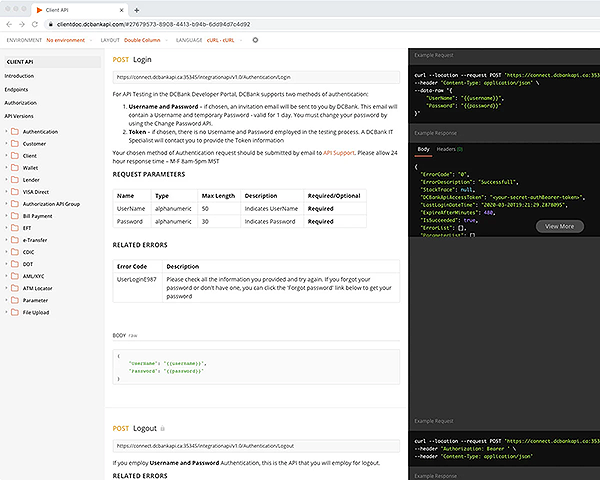
DCBank API documentation preview

What real-time looks like for your customers

The impact reaches the people who use your product, at the moment they need it.

A person confirming a completed payment on their phone in the evening

Saturday, 6:00 p.m.

A small online seller is settled before Monday

Maya runs a handmade goods shop on an online marketplace and has her best weekend of the year. Instead of waiting for Monday's batch, the marketplace settles her sales on the RTR through DCBank that evening.

For the marketplace: continuous merchant settlement that keeps sellers loyal.

For Maya: she can buy materials on Sunday and restock for the week.

Friday, 9:15 p.m.

A borrower is funded the moment they're approved

A family applies online for a loan to replace a broken furnace. The lender approves it in minutes and funds it on the RTR straight away, instead of on the next business day.

For the lender: fewer applicants drop off between approval and funding.

For the family: the installer is booked for Saturday morning, not next week.

Sunday, 4:05 p.m.

A homeowner's claim is paid the day it's filed

Hail damages a roof on Sunday afternoon. The insurer approves the emergency claim through its app and pays it on the RTR within minutes of approval.

For the insurer: a better claims experience, with fewer “where's my money?” calls.

For the homeowner: a roofer can start the repair right away.

Statutory holiday, 10:00 a.m.

A small supplier gets paid on the due date, holiday or not

A distributor pays its local bakery supplier on the invoice due date, which falls on a holiday. The payment settles in seconds, with the invoice number attached.

For the distributor: it holds cash until the due date and reconciles automatically.

For the bakery: it knows exactly what was paid, and can buy flour for the morning.

Illustrative scenarios. Names and businesses are fictional. Real-time payments require both the sending and receiving institutions to be live on the RTR. Participation is growing in phases.

The RTR can also support me-to-me transfers, real-time rent payments, payroll and real-time cash visibility for treasury teams.

Talk to our RTR team

RTR reach is growing. Start building now.

Every new participant widens who your customers can pay in real time. Build now and be ready.

Q4 2026 (now)

The RTR is live

The RTR launched on November 9, 2026, with its first participants, including DCBank. Businesses and fintechs can start building with us today.

Q1 2027 target

Interac e-Transfer® begins moving to the RTR

A first group of institutions starts clearing and settling Interac e-Transfer® payments on the RTR.

Q2 2027 target

More institutions join

More institutions move their e-Transfer clearing and settlement onto the RTR, widening the accounts your customers can reach.

Q3 2027 target

Initial participants at full volumes

All participants in the initial launch phases are targeted to run at full transaction volumes.

The RTR will be available to more than 9 in 10 Canadians within the first year after launch.

Quarters are Payments Canada targets and may change. Other participants go live as they're ready (Payments Canada: testing and launch).

Get started on the RTR with DCBank

From first conversation to live real-time payments, we guide you through each step.

Conversation icon

1. Talk to our RTR team

Tell us what you want to build, who you serve and your expected volumes.

Review icon

2. Onboarding and review

We complete onboarding, compliance and risk review, and agree limits for your flows.

Build icon

3. Build and test

Integrate with DCBank's APIs and test your payment flows in DCBank's sandbox.

Go live icon

4. Go live

Launch real-time payments to your customers, 24/7/365, and scale as RTR reach grows.

Talk to our RTR team

Real-Time Rail questions, answered

What is Canada's Real-Time Rail (RTR)?

The Real-Time Rail is Canada's national real-time payment system, operated by Payments Canada. It lets people and businesses, through their participating member, send and receive final, data-rich account-to-account payments, with exchange, clearing and settlement in real time, 24 hours a day, 365 days a year.

Source: Payments Canada: Real-Time Rail

When did the Real-Time Rail launch?

Payments Canada launched the Real-Time Rail on November 9, 2026, with a first group of participants that included Digital Commerce Bank (DCBank). More participants, including all major financial institutions, are planned to onboard in the coming months.

Source: Payments Canada launch announcement, Payments Canada: testing and launch

Is DCBank live on the Real-Time Rail?

Yes. DCBank went live at the launch of the Real-Time Rail on November 9, 2026, as one of the first participants. Clients send and receive RTR payments through new APIs DCBank developed for the RTR.

Source: DCBank launch announcement

Do I need to become a Payments Canada member to use the RTR?

No, not if you work with DCBank. Businesses, fintechs and payment service providers can send and receive RTR payments as DCBank clients, instead of becoming a participant and certifying their own connection.

Who can access the RTR through DCBank?

DCBank works with businesses and corporates, fintechs, payment service providers, lenders, payroll and earned wage access providers, and platforms that want to send or receive real-time payments in Canada. Eligibility is subject to DCBank's onboarding, compliance and risk review.

What is the RTR transaction limit?

The RTR has a system limit of $100,000 per payment at launch. Payments Canada will reevaluate the limit after launch, with a view to increasing it over time. Participants may set lower limits for their own clients.

Source: Payments Canada RTR FAQ

How fast are RTR payments?

RTR payments are exchanged, cleared and settled in real time. Once a payment settles, the recipient will generally have access to the funds within 60 seconds. The RTR Rules allow exceptions in certain circumstances.

Source: Payments Canada RTR FAQ

Can an RTR payment be reversed?

RTR payments are final and irrevocable. The only exceptions are limited cases set out in the RTR Rules, such as a payment sent in error or a suspected fraud. In those cases, the sending institution may request a return, but the receiving institution decides whether to send the funds back. That's why fraud and identity checks need to happen before the money moves.

Source: Payments Canada RTR FAQ

Who handles disputes about an RTR payment?

The institution you deal with directly handles complaints about fraud or errors. Every RTR participant must have customer complaint policies that explain when claims are investigated, when customers may be reimbursed, and how unresolved complaints are escalated. DCBank clients can raise concerns through our complaint handling process.

Source: Payments Canada RTR FAQ

How does the RTR protect against fraud?

Canada is the first G7 country to deploy a real-time payment system with mandatory centralized fraud services for use at launch. They include confirmation of payee for consumer accounts, a fraud safety score, a shared risk list and a fraud reporting platform. At DCBank, RTR payments also pass through our own fraud controls and round-the-clock monitoring. No payment system is immune to fraud.

Source: Payments Canada launch announcement

How is the RTR different from EFT?

EFT payments are cleared in batches through the Automated Clearing Settlement System (ACSS), Canada's retail batch payment system, and can take up to three days after the transaction to settle. RTR payments are exchanged, cleared and settled one at a time, in real time, every day of the year, and can carry ISO 20022 data such as invoice details. DCBank offers APIs for RTR payments as well as for all major Canadian payment products, including Interac e-Transfer® and EFT, so you can use each rail where it fits.

Source: Payments Canada: Real-Time Rail

What is ISO 20022 and why does it matter?

ISO 20022 is a global messaging standard for payments. On the RTR it lets structured data, such as invoice numbers and remittance details, travel with each payment, which makes automated reconciliation and compliance easier.

Source: Payments Canada: Real-Time Rail

How quickly can we get started with DCBank?

Timelines depend on your use case, volumes and onboarding review. Talk to the DCBank RTR team and we'll outline the path from testing in DCBank's sandbox to launch.